


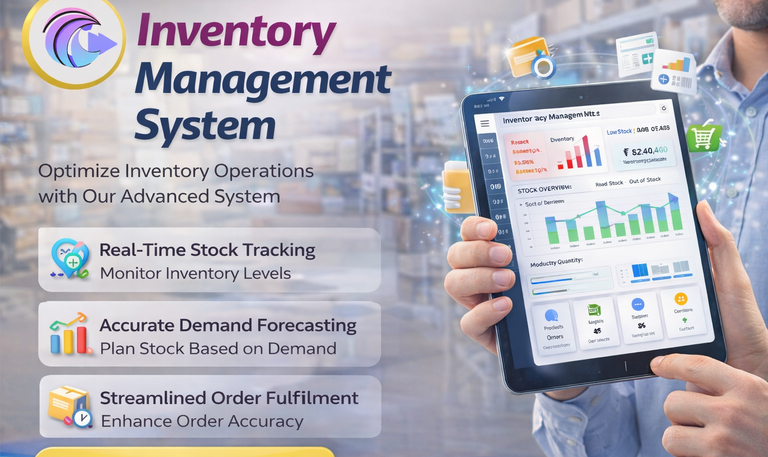
This guide reveals how a powerful inventory management system transforms stock control and streamlines operations for modern businesses. From AI-driven demand forecasting to real-time multi-warehouse visibility, discover essential features of an advanced stock management solution. Learn why Caz Brain builds custom inventory tracking software and warehouse management platforms that deliver measurable operational efficiency.
Inventory Management System: 7 Powerful Tips to Streamline Your Operations in 2026
An inventory management system is the operational backbone of every product-based business in 2026. Whether you manage a growing e-commerce brand in Bangalore, a multi-location retail chain in Kolkata, or a manufacturing unit supplying clients across the UK and Canada, the right stock management solution eliminates waste, prevents stockouts, and puts you in complete control of your supply chain.
The global inventory management software market was valued at USD 2.51 billion in 2025. Furthermore, it is projected to reach USD 4.79 billion by 2032, growing at a healthy 9.6% CAGR. SaaS-based platforms now dominate adoption, accounting for approximately 62% of total market share. Meanwhile, over 72% of small and medium businesses have already adopted some form of digital inventory tracking. These numbers confirm a clear trend. Businesses that fail to modernize their inventory control system risk losing money, customers, and competitive ground.
At Caz Brain, an IIT Patna incubated digital transformation company, we build custom inventory management systems that solve real supply chain challenges. Our development team combines artificial intelligence, IoT integration, and cloud-native architecture to deliver platforms that make stock management genuinely effortless for businesses of every size.
Why a Streamlined Inventory Management System Is Essential
Poor inventory management costs businesses dearly. According to industry research, inaccurate supply chain and inventory levels cause approximately $1.1 trillion in losses worldwide every year. Additionally, nearly 43% of warehouses deal with counting errors, mis-picks, or location mistakes that undermine fulfillment reliability. These are not small problems. They directly impact revenue, customer satisfaction, and operational efficiency.
The Real Cost of Manual Inventory Tracking
Manual inventory processes create invisible but expensive problems. Spreadsheet-based tracking leads to data entry errors. Physical stock counts consume dozens of labour hours monthly. Disconnected systems between warehouse, sales, and accounting departments create information silos. Consequently, businesses experience stockouts that frustrate customers, overstocking that locks up working capital, and dead stock that silently erodes profit margins.
The U.S. Department of Defense’s Acquipedia resource on Inventory Management emphasizes that effective inventory control requires balancing available resources against performance objectives while maintaining visibility down to retail levels. This principle applies equally to commercial businesses. Without real-time visibility, you are making expensive decisions based on outdated data.
How an Intelligent System Transforms Operations
A modern inventory tracking software centralizes every aspect of stock control into one unified platform. Purchase orders, goods receipts, stock movements, demand forecasting, reorder triggers, multi-location synchronization, and financial reporting all operate from a single source of truth. As a result, businesses reduce errors, accelerate fulfillment, and make data-driven decisions that directly improve profitability.
Moreover, cloud-based platforms enable teams across multiple warehouses, retail locations, and offices to access the same live inventory data simultaneously. Whether your warehouse operates in Kolkata, your sales team works from Mumbai, and your finance team sits in London, everyone sees the same accurate numbers in real time.
| Inventory Challenge | Manual Approach | With Inventory Management System | Operational Impact |
|---|---|---|---|
| Stock Counting | Physical counts, 2–3 days | Automated cycle counting with barcode/RFID | 90% faster accuracy |
| Demand Forecasting | Gut feeling + basic trends | AI-powered predictive analytics engine | 20–50% fewer forecast errors |
| Reorder Management | Manual monitoring + phone calls | Automated reorder points with threshold alerts | Zero stockout risk |
| Multi-Location Sync | Separate spreadsheets per site | Real-time cloud synchronization across all locations | 100% data consistency |
| Dead Stock Tracking | Discovered during annual audit | Continuous aging analysis with disposal alerts | 35% dead stock reduction |
| Purchase Orders | Manual creation + email chains | Automated PO generation from reorder triggers | 80% time saved |
| Financial Reporting | Month-end reconciliation | Real-time inventory valuation dashboards | Instant visibility |
7 Powerful Features of a Proven Inventory Management System
Not every warehouse management platform delivers transformative results. The best systems combine intelligent automation with intuitive workflows and deep integration capabilities. Here are 7 powerful features that separate exceptional inventory management systems from ordinary tools.
1. AI-Powered Demand Forecasting and Stock Optimization
Predicting what your customers will buy tomorrow is the foundation of efficient inventory control. An AI-driven inventory management system analyzes historical sales data, seasonal patterns, market trends, promotional calendars, and external signals to generate accurate demand forecasts. Furthermore, it automatically calculates optimal safety stock levels and economic order quantities for every SKU.
Companies using AI-powered inventory optimization report reductions in forecast errors of 20% to 50%. That translates directly into fewer stockouts, less overstocking, and significantly improved cash flow.
Caz Brain’s artificial intelligence services power smart forecasting modules that learn from every transaction and continuously improve prediction accuracy over time.
2. Real-Time Multi-Warehouse Stock Visibility
You cannot manage what you cannot see. A powerful inventory tracking software provides a unified, real-time view of stock across every warehouse, retail outlet, distribution center, and transit point. IoT sensors, barcode scanning, and RFID technology feed continuous data into the system, ensuring stock levels are always accurate.
This visibility is critical for businesses operating across multiple cities or countries. It prevents overselling, enables intelligent stock transfers between locations, and ensures every customer order is fulfilled from the nearest available source. The University of Tennessee’s Global Supply Chain Institute highlights that inventory management experience, including real-time visibility, is one of the core competencies for supply chain excellence.
Our software development team builds multi-warehouse dashboards that give you complete stock visibility across your entire supply chain network.
3. Automated Purchase Order and Reorder Management
Manual reordering wastes time and invites errors. An advanced inventory control system triggers purchase orders automatically when stock levels hit predefined reorder points. It calculates optimal order quantities based on demand forecasts, lead times, and supplier performance data. Additionally, it routes POs through approval workflows and sends them directly to suppliers.
This automation eliminates the risk of human oversight. No more forgotten orders. No more emergency purchases at premium prices. Your supply chain runs on autopilot, freeing your team to focus on strategic decisions instead of repetitive tasks.
4. Barcode, RFID, and IoT-Enabled Tracking
Accurate tracking is the heartbeat of effective stock management. A modern stock management solution supports barcode scanning for fast item identification, RFID tags for hands-free bulk scanning, and IoT sensors for real-time location and condition monitoring.
Barcode scanning alone reduces picking errors significantly and speeds up receiving processes. RFID technology takes this further by enabling simultaneous reading of multiple items, with passive tags readable from approximately 40 feet away. These technologies together create an accurate, auditable inventory trail from goods receipt through storage, picking, packing, and shipment.
5. Omnichannel Inventory Synchronization
Today’s businesses sell through websites, mobile apps, marketplaces, physical stores, and social commerce channels simultaneously. An effective warehouse management platform synchronizes inventory across every channel in real time. When a product sells on Amazon, the stock count updates instantly across your Shopify store, physical outlets, and warehouse system.
This omnichannel synchronization prevents overselling, reduces cancellations, and ensures customers always see accurate availability. Over 70% of global companies now manage inventories across three or more sales channels, making centralized synchronization essential.
Caz Brain’s ecommerce app development expertise ensures your inventory system integrates natively with all major e-commerce platforms and marketplace APIs.
6. Comprehensive Reporting, Analytics, and Business Intelligence
Data transforms inventory from a cost center into a strategic advantage. A powerful inventory management system provides detailed dashboards covering inventory turnover ratios, days of supply, carrying costs, dead stock percentages, supplier performance scores, and SKU-level profitability analysis.
Moreover, ABC analysis automatically categorizes your inventory into high-value, medium-value, and low-value segments. This enables focused attention on the 20% of products that typically generate 80% of revenue. Predictive analytics identify emerging trends, seasonal demand shifts, and potential supply disruptions before they impact operations.
7. Seamless ERP, Accounting, and CRM Integration
No inventory system operates in isolation. The best supply chain inventory tools integrate seamlessly with your ERP platform, accounting software, CRM system, point-of-sale terminals, and logistics partners. This integration eliminates data silos, ensures financial accuracy, and creates a unified operational ecosystem.
Over 61% of enterprise inventory deployments now integrate with ERP and order management systems. This connectivity is not optional. It is fundamental to operational efficiency.
Caz Brain’s ERP software development service builds unified platforms where inventory, finance, HR, and customer management work together seamlessly. Additionally, our dedicated inventory management solutions page details our specialized capabilities in this domain.
Industries That Achieve Powerful Results with Custom Inventory Systems
A tailored inventory management system delivers measurable value across diverse industries. Here’s how different sectors leverage these platforms to streamline operations.
E-Commerce and Online Retail
E-commerce businesses manage large, fast-moving inventories across multiple fulfillment centers and marketplace channels. They need real-time stock synchronization, automated replenishment, and intelligent demand forecasting to prevent overselling and ensure fast delivery.
Caz Brain’s ecommerce app development and app development services create integrated commerce-and-inventory ecosystems that scale with your business growth.
Manufacturing and Production
Manufacturers track raw materials, work-in-progress goods, and finished products across complex production cycles. Bill of materials management, production scheduling, and quality control checkpoints require tight inventory integration. Our software development team builds manufacturing-grade inventory systems with lot tracking, serial number management, and production planning modules.
Education and Institutional Asset Management
Schools, universities, and training institutions manage libraries, lab equipment, IT assets, and supplies. Our educational app development and student management system development services complement institutional inventory platforms that track assets across campuses.
Food and Restaurant Supply Chain
Perishable inventory demands expiry date tracking, FIFO (First In, First Out) enforcement, and temperature monitoring. Our food delivery app development expertise enables us to build food-industry inventory systems that prevent spoilage and ensure compliance with food safety regulations.
Healthcare and Pharmaceutical
Hospitals and pharmacies require strict lot-level tracking, expiry management, controlled substance monitoring, and regulatory compliance documentation. The U.S. GSA’s procurement and supply chain framework establishes rigorous standards for inventory governance that our platforms are designed to meet.
Why Caz Brain Is Your Ideal Inventory Management System Development Partner
At Caz Brain, we engineer inventory management systems that solve real operational challenges for businesses across industries. Our methodology combines deep technology capability with practical supply chain understanding.
Our Competitive Differentiators
- IIT Patna Incubated Startup: Research-backed innovation and academic rigor power every solution
- Full-Stack Development: UI/UX design, backend architecture, API development, cloud deployment, and ongoing maintenance under one roof
- AI and IoT Integration: Demand forecasting, predictive analytics, barcode/RFID integration, and IoT sensor connectivity distinguish our platforms
- Scalable Cloud Architecture: Whether you track 100 SKUs or 100,000, our systems scale elastically without performance issues
- Cross-Industry Expertise: Proven delivery across e-commerce, manufacturing, education, food service, healthcare, and enterprise verticals
Caz Brain’s website development services build powerful web-based inventory dashboards, while our digital marketing services help promote your products effectively once inventory operations are streamlined.
Explore our delivered work on our portfolio page and visit our testimonials to hear directly from our clients.
Interested in partnering with us? Visit our business partnership page or explore game app development if your inventory needs include gamified warehouse engagement tools.
Inventory Technology Trends Powering 2026 and Beyond
Staying ahead of technology trends gives your business a competitive supply chain advantage. Here are the most significant shifts reshaping inventory management systems in 2026.
Autonomous Warehouse Robotics Integration
Autonomous mobile robots (AMRs) now perform automated cycle counting and stock movement tracking, improving warehouse productivity by up to 31%. Modern inventory tracking software integrates directly with these robotic systems to maintain real-time accuracy without manual intervention.
Predictive AI and Machine Learning Optimization
AI-powered systems now analyze demand signals from weather patterns, geopolitical events, social media trends, and competitor pricing to anticipate inventory needs days or weeks in advance. This proactive approach prevents both stockouts and costly overstocking.
Sustainability and ESG Inventory Tracking
Environmental responsibility is becoming a business requirement. Over 25% of inventory platforms now include carbon footprint tracking for held inventory. Carrying costs are no longer purely financial. They include environmental impact, and ESG-conscious procurement is entering supply chain contracts.
Blockchain-Enabled Supply Chain Transparency
Blockchain technology creates immutable records of every inventory movement, from raw material sourcing through final delivery. This ensures product authenticity, prevents counterfeiting, and satisfies increasingly stringent regulatory traceability requirements.
Your Roadmap to Streamlined Inventory Operations with Caz Brain
Ready to take control of your inventory and streamline your operations? Follow this proven path.
Step 1: Share your product types, warehouse locations, sales channels, and biggest inventory pain points.
Step 2: We design a custom system blueprint with features prioritized by operational impact and ROI potential.
Step 3: Our agile team delivers a production-ready MVP within 8–12 weeks.
Step 4: We iterate, optimize, and scale based on real operational data and team feedback.
Step 5: Ongoing support, security patches, and feature enhancements keep your system ahead of the curve.
Contact Caz Brain Today
Let’s build your ideal inventory management system together.
📞 Phone: +918536097288 📍 Address: 12th Floor, Tower 2, Waterfall, Godrej Waterside, EN Block, Sector V, Bidhannagar, Kolkata, West Bengal 700091 🌐 Website: cazbraingroup.com 🔗 All Services: Explore Our Services
Frequently Asked Questions
1. What is an inventory management system and why is it essential for businesses? Caz Brain: An inventory management system is a digital platform that tracks, controls, and optimizes stock levels across your entire supply chain. It automates purchase orders, demand forecasting, stock counting, and multi-location synchronization. It is essential because poor inventory management causes approximately $1.1 trillion in global losses annually through stockouts and overstocking.
2. How does AI improve inventory tracking software for modern businesses? Caz Brain: AI enhances inventory tracking by analyzing historical sales data, seasonal trends, and external market signals to generate accurate demand forecasts. Companies using AI-powered optimization report 20% to 50% fewer forecast errors. AI also automates reorder triggers, identifies dead stock patterns, and optimizes safety stock calculations continuously.
3. Can Caz Brain build a custom inventory management system for my specific industry? Caz Brain: Absolutely. Caz Brain builds industry-specific inventory systems for e-commerce, manufacturing, healthcare, education, food service, and retail businesses. We customize features like lot tracking, expiry management, multi-warehouse sync, barcode/RFID integration, and omnichannel synchronization to match your operational requirements precisely.
4. How much does custom inventory management system development cost in India? Caz Brain: Costs depend on feature complexity, number of integrations, and scalability needs. A basic cloud-based inventory platform starts affordably, while enterprise-grade solutions with AI forecasting, IoT connectivity, and ERP integration require higher investment. Contact Caz Brain at +918536097288 for a free consultation and detailed project estimate.
5. Can a cloud-based stock management solution work for small businesses and startups? Caz Brain: Yes. Cloud-based inventory platforms are perfect for small businesses because they eliminate heavy infrastructure costs. You pay based on usage, access data from any device, and scale features as you grow. Over 72% of SMEs globally have already adopted digital inventory tracking, and cloud-based systems account for 63% of new installations.
6. Does the inventory management system integrate with existing ERP and accounting software? Caz Brain: Yes. Seamless integration is a core strength of our inventory solutions. We build systems that connect natively with popular ERP platforms, accounting software like Tally and QuickBooks, CRM tools, POS terminals, and logistics partners. Over 61% of enterprise inventory deployments now require ERP integration for unified data flow.
7. How quickly can Caz Brain develop and launch an inventory management system? Caz Brain: We deliver a production-ready MVP within 8 to 12 weeks using agile sprint-based development. The full-featured platform launches in 3 to 6 months through phased rollouts. This approach ensures faster time-to-market, continuous improvement through real user feedback, and zero disruption to your existing warehouse and sales operations.

