
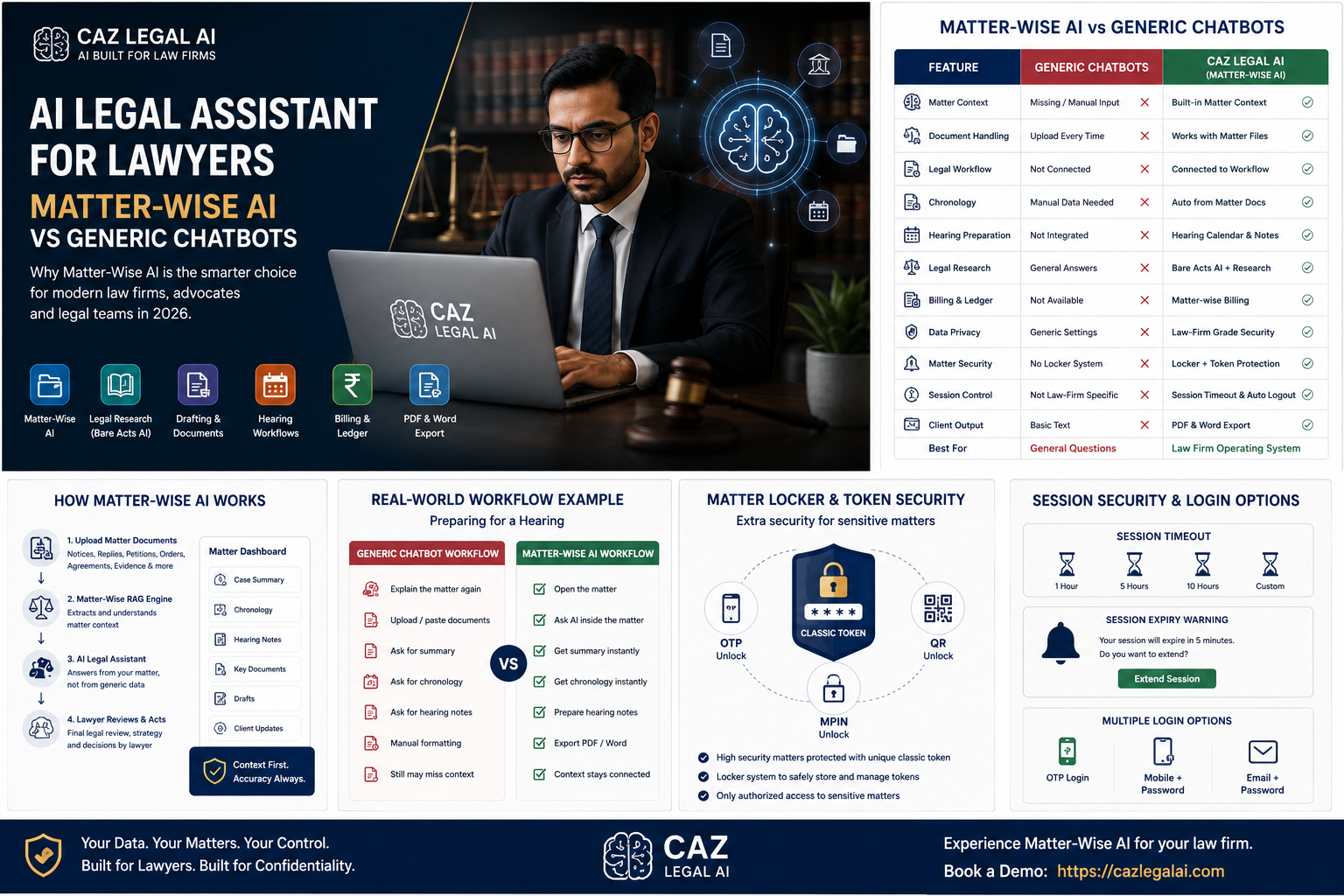
AI Legal Assistant for Lawyers: Matter-Wise AI vs Generic Chatbots
This article is structured for better readability, SEO depth, and AI-first understanding across enterprise workflows, RAG systems, SaaS, legal tech, healthcare, ecommerce, and automation.
An AI legal assistant for lawyers should do more than answer general legal questions. In 2026, law firms, advocates and legal teams need AI that can work inside real legal workflows: matters, documents, hearings, billing, research, drafting and client-ready outputs.
This is where the difference between a generic chatbot and Matter-Wise AI becomes important.
A generic chatbot can help with broad explanations, simple drafting ideas or general research prompts. But legal work is rarely generic. A lawyer usually needs answers based on a specific client, a specific matter, uploaded documents, hearing history, legal notices, replies, petitions, agreements, case notes and the current workflow stage.
Matter-Wise AI is designed for that context.
Caz Legal AI, developed by Caz Brain Group, is positioned as a Legal AI software platform for law firms, advocates and legal teams that need matter-specific intelligence, document-aware AI, legal research support, drafting assistance, hearing workflows, billing visibility and a complete law firm operating system with AI.
This guide explains the difference between generic legal chatbots and Matter-Wise AI, why law firms should avoid treating AI as only a chat window, and how Caz Legal AI helps lawyers move from scattered legal work to connected legal intelligence.
What is an AI legal assistant for lawyers?
An AI legal assistant for lawyers is software that supports legal professionals with research, document review, drafting, summarization, chronology preparation, matter questions, hearing preparation and workflow assistance.
A basic AI assistant may respond to prompts. A strong legal AI assistant should understand the legal workflow.
For a lawyer, the real value is not only whether the AI can produce text. The real value is whether the AI can help with the work that happens every day inside a law firm.
That includes:
Legal workflow area | What lawyers need |
|---|---|
Matter understanding | Quickly understand case facts, dates, parties, claims and documents |
Legal research | Search and interpret legal provisions, Bare Acts and legal concepts |
Drafting | Prepare notices, replies, petitions, summaries and client advisories |
Chronology | Organize events and important dates in sequence |
Hearing preparation | Prepare hearing notes and matter updates |
Client communication | Generate client-ready explanations and outputs |
Billing | Track matter-wise fees, paid amounts and outstanding dues |
Document output | Export polished PDF or Word files for review and sharing |
A good AI legal assistant for lawyers should support these workflows without replacing legal judgment. The lawyer remains responsible for legal strategy, review and final output.
What is a generic legal chatbot?
A generic legal chatbot is an AI chat interface that can answer legal questions, explain legal concepts or help draft general text based on user prompts.
It can be useful for basic tasks such as:
Generic chatbot use case | Example |
|---|---|
General explanation | “Explain what a legal notice is.” |
Basic drafting | “Draft a simple reply format.” |
Research prompt | “Explain this legal concept.” |
Summary | “Summarize this text.” |
Brainstorming | Give me points for a client advisory.” |
These tools can be helpful, but they are not automatically law firm software.
A generic chatbot usually does not know your matter structure, client records, hearing dates, billing details, document history or internal workflow. It may not understand which file belongs to which matter unless the user manually provides the context each time.
For lawyers, this creates a limitation. Legal work depends heavily on context.
If the AI does not understand the matter, it can only give a general response
What is Matter-Wise AI?
Matter-Wise AI is an AI system that works inside a specific legal matter using that matter’s own documents, facts, notes and workflow context.
Instead of asking a general chatbot a question in isolation, the lawyer can work with AI inside the matter workspace.
This means the AI can support questions like:
Matter-Wise AI question | Why it matters |
|---|---|
“What are the key facts in this matter?” | Helps with faster matter understanding |
“Create a chronology from these documents.” | Helps with hearing preparation |
“Summarize the client’s position.” | Supports client communication and case planning |
“What are the important dates?” | Helps lawyers identify timeline issues |
“Draft a reply based on this matter context.” | Supports document preparation |
“What should be reviewed before the next hearing?” | Helps improve matter readiness |
“Generate a client-ready summary.” | Supports professional legal output |
This is the core difference between a chatbot and a matter-aware AI legal assistant.
Caz Legal AI’s Matter-wise RAG Architecture is designed around this idea. It connects matter-specific retrieval with AI assistance so lawyers can work with uploaded documents, matter context and legal workflow more effectively.
Matter-Wise AI vs generic chatbots: the main difference
The most important difference is context.
A generic chatbot answers based on the current prompt. Matter-Wise AI works inside a matter.
Feature | Generic Chatbots | Caz Legal AI Matter-Wise AI |
|---|---|---|
Matter context | Usually missing unless manually provided | Built around specific matter workspace |
Uploaded documents | Must be added manually each time | Designed for matter files and document context |
Legal workflow | Not connected to law firm operations | Connected to matters, documents, hearings and outputs |
Chronology | Can generate if user provides enough text | Designed to support matter chronology workflows |
Legal drafting | Generic drafting assistance | Matter-aware drafting support |
Hearing preparation | Not connected to hearing calendar | Can support hearing notes and matter readiness |
Legal research | General legal explanation | Supports Bare Acts AI and legal research workflows |
Billing | Not available | Can connect with matter-wise billing workflow |
Client output | Basic text | Supports client-ready PDF and Word output |
Best use | General questions | Law firm operating system with AI |
This table is important because many law firms are now evaluating AI tools. The question should not be “Does this tool have AI?” The question should be “Is AI connected to my legal workflow?”
Why lawyers need matter-specific AI instead of only generic AI
Lawyers work with details. A small factual difference can change the meaning of a matter. A date, document, clause, hearing order, notice, reply or party name may be important.
That is why generic AI is not enough for professional legal workflow.
Lawyers need AI that can help with:
Lawyer requirement | Why generic AI may not be enough |
|---|---|
Matter-specific answers | Generic AI may not know the full matter file |
Document-heavy review | Manual upload and explanation takes time |
Hearing preparation | Generic AI does not track hearings |
Chronology | Generic AI needs all events provided again |
Billing and ledger | Generic AI does not manage financial workflow |
Client-ready output | Generic AI may produce unstructured responses |
Legal research workflow | Generic AI may not connect research to the matter |
Matter-Wise AI solves this by making the legal matter the center of the AI workflow.
How Caz Legal AI works as an AI legal assistant for lawyers
Caz Legal AI is designed to support the full legal workflow, not just one isolated chat feature.
The platform includes:
Caz Legal AI feature | Purpose |
|---|---|
Matter-Wise AI | AI assistant inside a specific legal matter |
Global Legal AI | Broader AI assistant for legal questions and document support |
Bare Acts AI | Legal research support for provisions and statutory context |
Matter management | Organize cases, files, notes, documents and workflows |
Client management | Manage client records connected to legal matters |
Hearing calendar | Track upcoming hearings and matter-specific dates |
Billing and ledger | Manage fees, paid amounts and outstanding dues |
Document intelligence | Support summaries, chronology, drafting and explanations |
PDF and Word output | Prepare client-ready legal documents |
Voice and chat onboarding | Help users move through the software more easily |
This makes Caz Legal AI relevant for commercial searches such as AI legal assistant for lawyers, Legal AI software for law firms, matter management software with AI, law firm CRM with AI, legal document AI and LegalTech software India.
Caz Legal AI product platform:
Caz Brain Group Legal AI solution page:https://cazbraingroup.com/solutions/caz-legal-ai
What is Global Legal AI?
Global Legal AI is a broader AI assistant that supports general legal questions, document explanation, legal drafting ideas and workflow guidance outside one specific matter.
It is useful when a lawyer needs:
Global Legal AI use case | Example |
|---|---|
Legal concept explanation | Understanding a legal term or provision |
Drafting support | Creating a general structure for a notice or advisory |
Document explanation | Explaining uploaded text or legal content |
Research assistance | Exploring a general legal issue |
Workflow guidance | Understanding how to proceed with a legal task |
Global Legal AI and Matter-Wise AI serve different purposes.
Matter-Wise AI is for case-specific context.Global Legal AI is for broader legal assistance.
A serious Legal AI platform should provide both.
What is Bare Acts AI and why does it matter?
Bare Acts AI is a legal research layer that helps lawyers search and understand legal provisions using AI-assisted reasoning.
For Indian legal workflows, this can include BNS, BNSS, BSA and constitutional law context.
This matters because lawyers often need to move between matter documents and legal provisions. A legal research AI layer helps reduce friction between research and drafting.
For example:
Legal research need | How Bare Acts AI helps |
|---|---|
Search legal provisions | Helps locate relevant statutory context |
Understand a section | Supports explanation of legal provisions |
Connect law to matter | Helps lawyers think through matter relevance |
Draft legal notes | Supports structured explanation |
Prepare client advisory | Helps convert legal points into readable output |
Bare Acts AI should not replace legal research judgment. It should support lawyers in reaching relevant legal context faster.
How AI legal assistants support legal drafting
AI legal assistants can support legal drafting by helping lawyers prepare first drafts, structures, summaries, notices, replies, petitions and client advisories.
However, legal drafting must remain lawyer-reviewed.
A Legal AI platform can support:
Drafting workflow | AI support |
|---|---|
Legal notice | Draft structure and key points |
Reply to notice | Matter-based response support |
Petition | Issue and fact organization |
Civil plaint | Drafting structure support |
Written statement | Response point organization |
Client advisory | Plain-language explanation |
Agreement draft | Clause structure support |
Chronology | Date-wise timeline generation |
Case summary | Matter overview and key facts |
Hearing note | Preparation points before hearing |
This is why the keyword “AI drafting tool for advocates” should be understood carefully. The best AI drafting tool is not just a text generator. It should understand the matter and help the advocate create review-ready outputs.
Why legal document AI is important for advocates
Legal document AI helps lawyers work with large volumes of documents more efficiently.
Many matters involve:
NoticesRepliesPetitionsOrdersAgreementsAffidavitsEvidence filesCourt recordsClient notesEmailsHearing updatesBilling records
Without AI, lawyers or staff often need to manually read, organize and summarize these materials.
With document-aware Legal AI, the platform can help identify key facts, summarize documents, prepare chronology, extract points and support drafting workflows.
This does not remove the lawyer’s role. It helps lawyers spend less time on repetitive document handling and more time on strategy, client advice and final legal review.
How does Matter-Wise AI reduce hallucination risk?
Matter-Wise AI reduces hallucination risk by grounding AI responses inside a specific matter workspace instead of depending only on broad generic prompts. In a generic chatbot, the user may need to manually explain the matter, paste documents, add facts and repeat context again and again. This increases the chance of incomplete or disconnected responses.
Caz Legal AI’s Matter-wise RAG Architecture is designed to work differently. It connects the AI assistant with uploaded matter documents, case context, matter notes and legal workflow records. This helps the AI respond from the available matter context rather than giving only a general answer.
This is important for lawyers because legal work cannot depend on unsupported assumptions. A legal AI assistant should help the lawyer review matter context, identify useful points, prepare summaries, support drafting and organize chronology, while the final legal review always remains with the advocate or qualified legal professional.
Risk area | Generic chatbot risk | Matter-Wise AI approach |
|---|---|---|
Case context | User must explain the matter manually | AI works inside a specific matter workspace |
Document grounding | Documents may be missing from the prompt | Uploaded matter files can be connected to the AI workflow |
Repeated context | Lawyer may need to repeat facts again and again | Matter context remains organized inside the case workflow |
Hallucination risk | Higher risk of generic or unsupported output | Responses are more grounded in matter-specific documents |
Legal review | User may treat output as a final answer | Lawyer remains responsible for final legal review |
Workflow accuracy | Chat history may become disconnected | Matter data, documents and outputs stay connected |
Law firm CRM with AI: why it is different from normal CRM
A normal CRM manages leads, contacts, follow-ups and customer relationships.
A law firm CRM with AI must do much more.
Law firms manage clients, matters, documents, court dates, hearings, billing, research and legal outputs. That is why a normal CRM cannot fully handle legal operations.
CRM area | Normal CRM | Law firm CRM with AI |
|---|---|---|
Contact management | Stores names and details | Connects clients to legal matters |
Follow-up | Sales follow-up | Matter, hearing and document follow-up |
Documents | Basic attachments | Matter-wise legal files and AI document intelligence |
Calendar | General reminders | Hearing calendar and case preparation |
Billing | Sales invoice support | Matter-wise legal billing and ledger |
AI | Generic email or sales AI | Matter-specific legal AI assistant |
Output | Sales communication | Legal summaries, advisories and documents |
Caz Legal AI is closer to a law firm operating system with AI than a normal CRM.
What is a law firm operating system with AI?
A law firm operating system with AI is a connected platform for managing the daily operations of a legal practice.
It should connect:
Client intakeMatter creationDocument managementLegal researchDraftingChronologyHearing trackingBillingTeam workflowClient-ready outputsAI assistance
When these areas are connected, lawyers can work with better visibility.
Instead of switching between spreadsheets, folders, calendar tools, billing records and generic AI tools, the law firm can work inside one structured system.
Caz Legal AI is being built in this direction.
Real-world workflow example: generic chatbot vs Matter-Wise AI
Imagine a litigation lawyer preparing for a hearing.
In a generic chatbot workflow, the lawyer may need to copy facts, upload text, explain the case, paste relevant documents and ask the chatbot to summarize. If the next question needs more context, the lawyer may need to explain again.
In a Matter-Wise AI workflow, the matter workspace already contains the relevant documents and context. The lawyer can ask questions inside the matter and work with the AI in relation to that specific case.
Hearing preparation task | Generic chatbot workflow | Matter-Wise AI workflow |
|---|---|---|
Understand matter facts | User must explain facts manually | AI works with matter context |
Review documents | User must upload or paste files repeatedly | Matter files are connected to the workspace |
Prepare chronology | User must provide timeline material | AI can support chronology from matter documents |
Draft hearing note | User must explain matter background again | AI can use matter-aware context |
Generate client update | User must format manually | Platform can support client-ready output |
Track next hearing | Not available | Connected with hearing workflow |
This example shows why law firms should think beyond generic legal chatbots.
Who should use an AI legal assistant for lawyers?
An AI legal assistant is useful for:
User type | Why it helps |
|---|---|
Independent advocates | Faster drafting, research and matter organization |
Small law firms | Better client, matter and document workflow |
Mid-sized law firms | Structured team operations and hearing tracking |
Litigation teams | Chronology, hearing notes and document-heavy matters |
Corporate legal teams | Document review, research and advisory workflows |
Legal operations teams | Workflow visibility and task organization |
International practices | Managing diverse document sets and multi-jurisdictional workflows |
Indian advocates | Bare Acts AI, BNS, BNSS, BSA and matter management support |
The strongest fit is for law firms that handle many matters, many documents, repeated drafting workflows and frequent hearing preparation.
Who should not use Legal AI software?
Legal AI software is powerful, but it is not the right fit for every firm at every stage.
Caz Legal AI may not be the best fit for:
Not ideal for | Reason |
|---|---|
Firms needing only simple file storage | They may not need a full AI workflow |
Teams not ready to digitize documents | Matter-wise AI needs structured digital input |
Users expecting AI to replace lawyers | Legal review must remain with professionals |
Firms avoiding workflow structure | Legal AI works best with organized matters |
Practices needing only a calendar | They may not need a law firm operating system |
This honest fit assessment matters. Legal AI should be treated as a responsible productivity layer, not a shortcut for legal
judgment.
Legal AI readiness checklist for law firms
Use this checklist before choosing an AI legal assistant:
Readiness question | Yes / No |
|---|---|
Does your firm manage multiple clients and matters at the same time? | |
Do your lawyers spend time searching through PDFs, notices, replies, petitions, orders and case files? | |
Do you need faster chronology, case summaries or hearing preparation notes? | |
Do you want legal research, matter management, billing and document output in one system? | |
Do you need AI assistance inside specific matters, not only generic chat? | |
Do you want PDF or Word outputs that can be reviewed and shared with clients? | |
Do you need a law firm CRM with AI, matter management software and billing workflow together? | |
Are you ready to digitize matter files and organize legal workflows properly? |
If the answer is yes to most of these points, your firm may be ready for a Matter-wise Legal AI platform such as Caz Legal AI.
How to choose the best AI legal assistant for lawyers
Before choosing an AI legal assistant, evaluate these points:
Evaluation point | Why it matters |
|---|---|
Matter context | Legal work depends on specific case facts |
Document intelligence | Lawyers work with many documents |
Legal research support | Research should connect with workflow |
Drafting support | Drafts should be review-ready and structured |
Hearing workflow | Litigation teams need hearing preparation |
Billing and ledger | Law firms need financial visibility |
PDF and Word outputs | Lawyers need client-ready documents |
Security and privacy | Legal data must be handled responsibly |
Law firms should avoid choosing software only because it has an AI chat box. The better question is whether AI is integrated into the full legal workflow.
Why Caz Legal AI is different from generic legal chatbot tools
Caz Legal AI is different because it is designed as a Legal AI software platform for law firms, not only a chatbot.
It combines:
Matter-Wise AIGlobal Legal AIBare Acts AIMatter managementClient managementHearing managementBilling and ledgerDocument intelligenceCourt data workflowVoice and chat onboardingPDF and Word outputs
This structure supports the commercial keyword cluster around AI legal assistant for lawyers, Legal AI software for law firms, law firm CRM with AI, matter management software with AI, legal document AI, AI drafting tool for advocates and law firm operating system with AI.
Caz Legal AI product platform:https://cazlegalai.com/
Best Legal AI software guide:https://cazbraingroup.com/insights/best-legal-ai-software-law-firms-2026
Legal AI case study:https://cazbraingroup.com/case-studies/legal-ai-law-firm-software-matter-wise-global-ai
Matter-Wise RAG case study:https://cazbraingroup.com/case-studies/legal-ai-matter-wise-rag
Author’s note from Caz Brain Group
Caz Legal AI was built because legal teams need AI inside the workflow, not outside it.
A lawyer does not only need a general answer. A lawyer needs support with the actual matter, the actual documents, the actual hearing schedule, the actual drafting requirement and the actual client-ready output.
Caz Brain Group is building Caz Legal AI as a serious LegalTech platform for advocates, law firms and legal teams that want matter-wise intelligence, legal research, document automation and law firm workflow control in one system.
Final thoughts
The future of AI legal assistants for lawyers is not generic chat. It is matter-aware legal workflow.
Generic chatbots can help with broad questions, but law firms need systems that understand matters, documents, research, drafting, hearings, billing and client outputs.
Matter-Wise AI is a stronger approach because it puts the legal matter at the center of the AI experience.
Caz Legal AI is being built for this shift. With Matter-Wise AI, Global Legal AI, Bare Acts AI, law firm CRM with AI, document intelligence, hearing management, billing workflows and client-ready outputs, it is positioned as a complete Legal AI platform for modern lawyers, advocates and legal teams.
Data privacy and security in Legal AI
For lawyers, confidentiality is not optional. It is a professional responsibility. Any AI legal assistant for lawyers must be designed with data privacy, document security, session protection and matter-level access control in mind.
Caz Legal AI is being built with this requirement at the center of the platform. Legal data is sensitive because it can include client details, case documents, notices, replies, petitions, orders, evidence files, billing records, legal strategy, hearing notes and internal firm communication.
This is why Caz Legal AI is designed as more than a chatbot. It is a law firm operating system with AI where security controls can be connected to matters, documents, users and sessions.
Matter-level locker system
Caz Legal AI includes a matter-level locker concept for sensitive matters and documents. When a lawyer creates a matter, the system can ask how much security should be applied to that matter. If higher security is selected, a unique classic token can be generated for that matter.
This token works as an additional access layer. If someone tries to open that protected matter, the system can ask for the token before access is allowed.
Because lawyers may manage many matters and cannot remember every token manually, Caz Legal AI includes a locker system where the lawyer can securely view, copy or open the token when needed. The locker itself is protected by additional security options.
Locker unlock options
The Caz Legal AI locker can be protected through multiple unlock methods. This gives law firms flexibility based on their internal security preference.
Locker security option | How it helps law firms |
|---|---|
OTP-based locker unlock | Adds verification before accessing protected matter tokens |
QR-based locker unlock | Allows secure access through QR-based verification flow |
MPIN-based locker unlock | Allows faster protected access using a private MPIN |
Matter token protection | Adds a matter-level access layer for sensitive cases |
Token locker | Helps lawyers manage multiple matter tokens securely |
Protected matter access | Reduces unauthorized access risk for high-security matters |
Session timeout and login security
Caz Legal AI also supports session-based security. At the time of login, the user can choose or apply a session timeout duration. For example, a lawyer may select a one-hour session, five-hour session or longer working session based on firm policy and work requirement.
When the session time is close to expiry, the platform can show a warning message before logout. The user can choose to extend the session if they are actively working. If the session is not extended, the system can log out automatically and ask the user to authenticate again.
This is important for law firms because lawyers may access legal software from office systems, court environments, shared devices, home systems or travel situations. Automatic session expiry helps reduce the risk of unattended access.
Security feature | Purpose | Law firm benefit |
|---|---|---|
Session timeout selection | Allows controlled login duration | Reduces unattended session risk |
Auto logout | Ends session after selected time | Protects matters if user forgets to log out |
Session expiry warning | Alerts user before logout | Prevents work interruption |
Extend session option | Allows active users to continue | Supports long legal work sessions |
Token-wise session control | Keeps login access time-bound | Improves access discipline |
Re-authentication | Requires login again after expiry | Adds another protection layer |
Multiple login options
Caz Legal AI is designed to support multiple login methods so that law firms can choose the most practical access flow for their users.
Login method | Use case |
|---|---|
OTP login | Useful for quick verified access |
Mobile number and password login | Useful for mobile-first users and advocates |
Email ID and password login | Useful for law firms and office users |
Session-based authentication | Controls how long access remains active |
Token-based protection | Adds additional security for protected matters |
Why security matters for Legal AI software
Legal AI software must protect client trust. A law firm may use AI for matter understanding, document review, drafting support, hearing preparation and legal research, but the platform must also protect who can access the matter and for how long.
Caz Legal AI’s security direction is built around this idea:
Legal security concern | Caz Legal AI security direction |
|---|---|
Sensitive client documents | Matter-level locker and protected access |
Multiple matters per lawyer | Token locker for managing secured matter tokens |
Unauthorized matter access | Token verification for high-security matters |
Shared or unattended systems | Session timeout and auto logout |
Long legal work sessions | Session warning and extend option |
Flexible authentication | OTP, mobile/password and email/password login |
Matter confidentiality | Matter-level access control and structured workflow |
Caz Legal AI does not treat security as an extra feature. Security is part of the legal workflow because legal professionals need confidentiality, control and accountability when using AI-powered law firm software.
Frequently Asked Questions
What is an AI legal assistant for lawyers?
An AI legal assistant for lawyers is software that helps legal professionals with research, document review, drafting, matter questions, chronology, hearing preparation and legal workflow support. A strong AI legal assistant should work inside the law firm workflow, not only answer general questions.
What is the difference between a legal chatbot and Matter-Wise AI?
A legal chatbot usually gives general answers based on prompts. Matter-Wise AI works inside a specific legal matter using matter documents, case context and legal workflow data to provide more relevant support.
Can AI legal assistants help advocates with drafting?
Yes. AI legal assistants can support drafting workflows such as legal notices, replies, petitions, summaries, chronology, client advisories and hearing notes. Final legal review should always remain with the advocate or qualified legal professional.
Is Caz Legal AI only for large law firms?
No. Caz Legal AI can support independent advocates, small law firms, mid-sized law firms and legal teams that need matter management, document intelligence, legal research, hearing workflow and billing support.
Does Caz Legal AI replace lawyers?
No. Caz Legal AI does not replace lawyers. It supports lawyers by helping with document review, matter understanding, legal research, drafting support, hearing preparation and workflow organization.
What is Matter-Wise AI?
Matter-Wise AI is AI that works inside a specific legal matter using uploaded documents, matter records and case context. It helps lawyers ask matter-specific questions, prepare chronology, create summaries and support drafting workflows.
Can Caz Legal AI help Indian advocates?
Yes. Caz Legal AI is designed for advocates, law firms and legal teams, including Indian legal workflows. It includes Bare Acts AI support for legal research context such as BNS, BNSS, BSA and constitutional law.
Where can I try Caz Legal AI?
You can visit the Caz Legal AI product platform at https://cazlegalai.com/ or explore the Caz Brain Group Legal AI solution page at https://cazbraingroup.com/solutions/caz-legal-ai.
Is client data safe with Caz Legal AI?
Caz Legal AI is designed with legal workflow security in mind. It supports matter-level protection, secure locker access, token-based matter control, session timeout, auto logout and multiple login methods such as OTP, mobile/password and email/password login.