
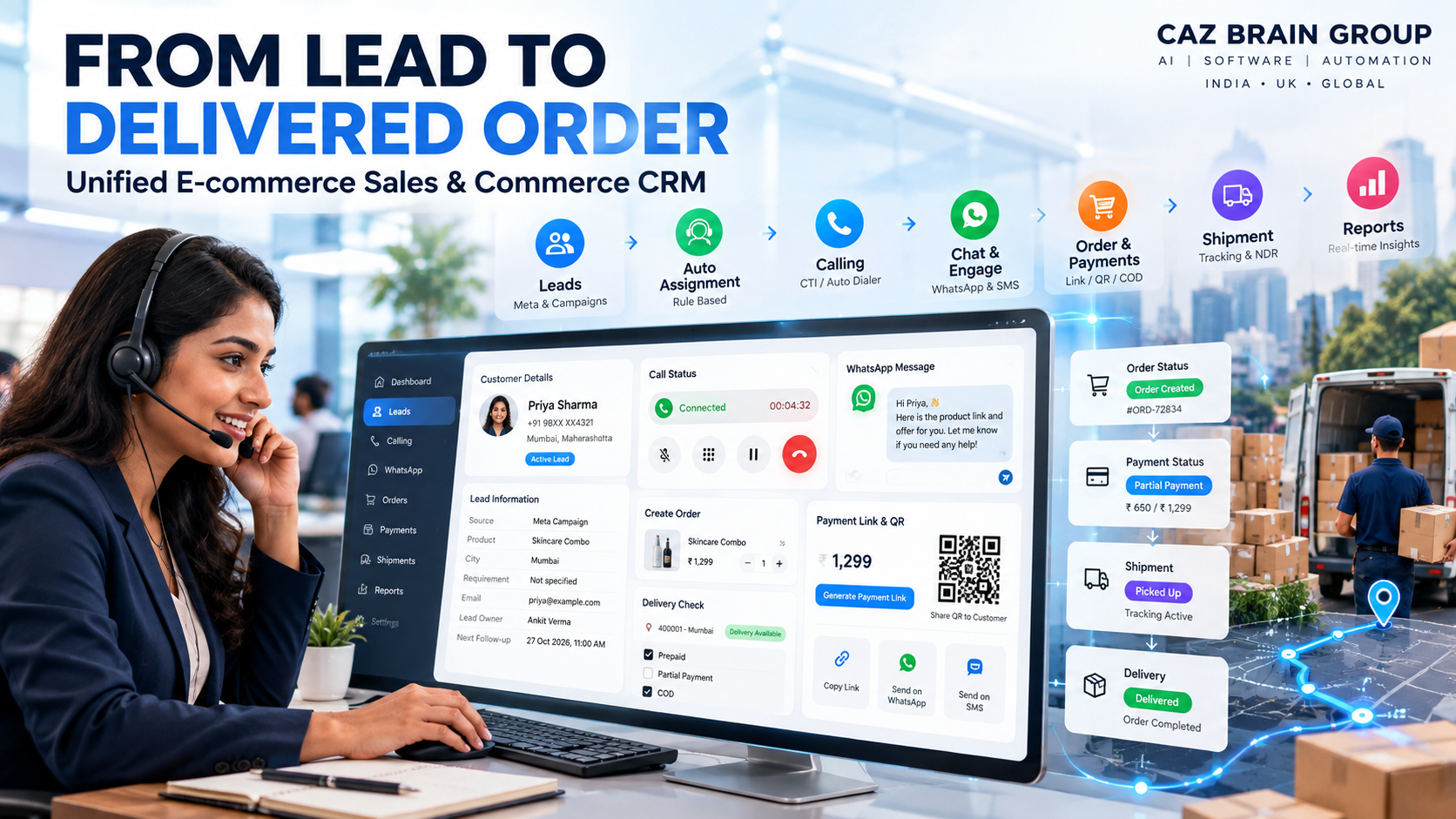
From Meta Lead to Order Delivery: The Future of E-commerce CRM in 2026
This article is structured for better readability, SEO depth, and AI-first understanding across enterprise workflows, RAG systems, SaaS, legal tech, healthcare, ecommerce, and automation.
From Meta Lead to Order Delivery: The Future of E-commerce CRM in 2026
How Caz Brain Group is engineering a connected sales, payments and commerce automation platform for e-commerce, D2C and FMCG businesses
By Caz Brain Group — Product Engineering Team | October 2026
The next generation of e-commerce CRM goes beyond lead management
For many e-commerce and direct-to-consumer businesses, generating a lead is only the beginning.
A customer submits an enquiry through Facebook or Instagram. A telecalling agent follows up. Product information is shared through WhatsApp. An order is created in another system. The payment team generates a link. A verification team checks the order. A logistics platform manages dispatch, and a separate team handles failed deliveries.
The customer journey may involve five or six different systems before an order reaches its destination.
This fragmentation creates operational challenges: disconnected records, repeated data entry, slower follow-ups, incomplete payment visibility, security concerns and difficulty understanding which marketing campaigns generate successfully delivered orders.
Caz Brain Group has been developing an integrated commerce CRM designed to connect these operational stages within a common workflow.
The platform combines lead management, rule-based assignment, agent calling, WhatsApp communication, order booking, payment workflows, verification and reporting. Shipping and non-delivery-report automation form part of its expanding integration roadmap.
The aim is straightforward: make the transition from lead generation to commerce execution easier to operate, monitor and scale.
What is an e-commerce CRM?
An e-commerce CRM is a customer relationship management system designed around the needs of online product-selling businesses.
Traditional CRMs commonly focus on contact records, sales pipelines, opportunities and follow-up activities.
An e-commerce-focused CRM must also understand products, quantities, customer addresses, payment modes, order states, delivery eligibility and post-order operations.
A business selling consumer products through telecalling may need its CRM to answer several questions simultaneously:
- Which advertising campaign generated the enquiry?
- Which agent is responsible for the customer?
- Has the agent contacted the customer?
- Was product information sent through WhatsApp?
- Has an order been created?
- Is the customer's PIN code serviceable?
- Is COD available for the selected destination?
- Has the customer completed a full or partial payment?
- Has the order passed verification?
- What happened after dispatch?
A connected commerce CRM brings these questions into one operational picture.
Why e-commerce and FMCG businesses need a different CRM approach
A business selling FMCG products, personal care products, wellness products, household goods or other consumer merchandise may receive hundreds or thousands of enquiries across multiple campaigns.
Not every enquiry becomes an order, and not every booked order becomes a successful delivery.
For these businesses, tracking leads alone does not provide enough information.
Managers also need to understand booking quality, payment outcomes, verification results, dispatch readiness and eventual delivery performance.
This becomes especially important when a business uses cash on delivery, partial prepaid arrangements, field verification or outsourced calling teams.
A commerce-oriented CRM should therefore connect the customer journey, sales workflow and order lifecycle, while maintaining clear responsibility between agents, supervisors, verification teams and administrators.
1. Automated lead capture and distribution
A disconnected sales process often begins with manual lead handling.
Enquiries are downloaded from advertising platforms, copied into spreadsheets and distributed to employees. Delays or duplicate assignments can occur before the first call is made.
The Caz Brain CRM architecture supports centralised lead records, campaign identification, source tracking, agent ownership and assignment rules.
Meta lead integration helps marketing enquiries enter a structured sales workflow.
Depending on configured rules, leads can be organised by campaign, agent and product requirements.
For management, this improves visibility into where an enquiry originated and who is responsible for the next action.
For agents, it creates a clearer daily work queue.
2. An integrated telecalling workspace
One of the defining product capabilities is the agent workspace.
Instead of making a call in one tool, updating customer details in another and entering an order elsewhere, the agent works from a consolidated interface.
The workspace is designed to bring together customer information, campaign details, product context, call controls, dispositions, follow-up dates, WhatsApp actions and order workflows.
Caz Brain Group has integrated Cube/QuickCube CTI capabilities within this architecture, including agent and extension mapping.
Other compatible dialer providers can potentially be integrated through their APIs, depending on the provider's available capabilities and technical requirements.
The practical benefit is not merely click-to-call. It is connecting the call with the commercial action that follows it.
3. WhatsApp communication without leaving the sales screen
During a live customer conversation, an agent often needs to send information immediately.
This might include product details, a product link, an approved WhatsApp template or a payment instruction.
If the agent must leave the calling interface to open a separate messaging system, the customer interaction becomes less coordinated.
The CRM's WhatsApp workflow allows customer communication to take place from within the CRM environment.
The broader WhatsApp module supports conversation management, template-based messaging, incoming and outgoing message handling, campaign workflows and message-status tracking, subject to the connected provider's permissions and policies.
For a telecalling team, the workflow becomes more natural:
Speak with the customer → share relevant information → answer questions → continue the order conversation.
This is particularly useful for businesses where product education and customer reassurance are important before checkout.
4. Convert a customer call into an order
Many lead-management platforms stop at a status such as “Interested” or “Converted.”
For an e-commerce business, that is not always enough.
A meaningful sales outcome should connect to an actual product order.
Caz Brain's commerce CRM supports order booking within the sales workflow, allowing authorised agents to select products, quantities and payment options while working with the customer.
Order records can remain associated with the original customer and sales agent.
The CRM can then distinguish between a lead that has simply expressed interest and a lead associated with a created order.
This connection is important for accurate booking reports, sales accountability and verification workflows.
It also reduces dependence on repeatedly transferring customer details between applications.
5. Payment links, QR codes, COD and partial payments
Payment handling is one of the platform's strongest commercial features.
The CRM has been developed around integrated payment workflows, including Cashfree payment capabilities.
Agents can work with payment actions from within their authorised CRM workspace rather than requiring direct access to the payment gateway's administrative dashboard.
Supported commerce workflows include prepaid orders, cash on delivery and partial-payment arrangements.
Where enabled and configured, a payment link or QR code can be generated and shared with the customer.
The CRM maintains payment-related information alongside the order, allowing authorised teams to understand the transaction's current state.
This approach offers an important operational distinction:
An agent can initiate the approved payment collection workflow without being given unrestricted payment gateway administration privileges.
Actual payment authorisation, settlement and transaction status remain governed by the connected payment provider.
For businesses handling high order volumes, this separation can improve operational control and reduce unnecessary system access.
6. PIN-code serviceability and payment-mode eligibility
Not every delivery destination supports the same shipping and payment options.
Some locations may support prepaid delivery but not COD. Others may have limited courier coverage or additional operational restrictions.
A sales agent benefits from checking serviceability before confirming an order.
The CRM's commerce workflow is designed to surface PIN-code delivery eligibility and available payment or delivery options based on connected serviceability information.
This makes it easier to communicate realistic options to customers while preparing orders.
Serviceability accuracy depends on the connected logistics or shipping provider and its latest coverage data.
7. Order verification as a separate operational stage
An order created by an agent should not necessarily be dispatched immediately.
Many high-volume consumer-product businesses use verification teams to check customer details, order accuracy and readiness for fulfilment.
Caz Brain's CRM separates sales activity from order verification.
An order may move through stages such as:
Order created → Unverified → Verified / Future order / Cancelled
This allows the verification function to operate independently from the sales team.
It also provides managers with clearer visibility into the difference between gross bookings and orders approved for further processing.
For businesses that rely heavily on COD, verification can be a useful control before committing fulfilment resources.
8. Shipment automation and the next stage of integration
After verification, an order enters the fulfilment process.
This is where many organisations begin switching between CRM systems, shipping dashboards and courier tracking tools.
Caz Brain Group is extending the platform toward logistics-provider integrations, including planned Shiprocket and One Delivery workflows.
The intended architecture connects order information to shipment creation and then returns tracking and delivery events to the CRM.
Relevant shipment events may include order dispatched, airway bill generated, shipment picked up, out for delivery, delivered, delivery attempt failed and returned to origin.
The extent of automation depends on completing the provider integrations, testing their APIs and enabling the corresponding business workflows.
The longer-term objective is to keep operational teams informed without requiring manual tracking across disconnected dashboards.
9. NDR management for failed-delivery operations
NDR stands for Non-Delivery Report.
In e-commerce logistics, an NDR generally indicates that a delivery attempt could not be completed, often because the customer was unavailable, the address required clarification or another delivery issue occurred.
For businesses with significant COD volumes, unresolved delivery exceptions can create considerable operational workload.
The CRM's NDR module is part of the fulfilment roadmap and is intended to support delivery-exception queues, customer follow-ups, courier-status integration and re-attempt coordination.
A connected NDR process can help teams identify which orders require attention, understand the delivery issue and record subsequent actions.
Once integrated, this would extend the platform's scope beyond sales conversion into post-order operations.
10. Customer-number masking and role-based control
Customer contact information is sensitive business data.
In large telecalling teams, not every employee needs unrestricted visibility into complete customer phone numbers or all administrative systems.
The CRM architecture incorporates customer-number masking within agent workflows.
Calling and authorised messaging can be routed through internal integrations without requiring agents to manually handle the complete number in their everyday interface.
Functional roles include agents, supervisors, verification users and administrators, with access designed around their responsibilities.
Number masking is a useful operational safeguard, although it is not a substitute for encryption, access logging, legal compliance or a broader data-security programme.
11. Management analytics beyond basic lead counts
A commerce CRM can generate a more complete picture of sales performance when customer interactions, order records and payment events are linked.
Useful measures include:
- Leads received and assigned
- Calls attempted and connected
- Follow-ups due
- Orders created
- Verification outcomes
- Payment modes and payment states
- Campaign performance
- Agent productivity
- Cancellation trends
After shipping integration is completed, logistics measures such as shipment status, NDR cases and delivered-order outcomes can be incorporated.
This provides a foundation for distinguishing marketing-driven enquiries from actual commercial results.
12. Where AI fits into commerce CRM automation
AI can be valuable in commerce operations, but it is important to distinguish rule-based automation from machine-learning capabilities.
The current Caz Brain CRM uses integrated workflows, configured rules, system events and API connections across the sales journey.
Its architecture can be extended with capabilities such as AI-assisted call summaries, automated conversation analysis, lead-priority recommendations, agent-assist knowledge retrieval and delivery-exception analysis.
These are potential AI enhancements and should not be confused with capabilities already deployed and validated in the current CRM.
The most useful AI applications are those connected to a measurable business need, such as reducing repetitive administrative work or helping a supervisor identify conversations that require attention.
13. Industries that can benefit from a unified commerce CRM
E-commerce and D2C brands
Businesses selling consumer products through advertisements, websites, WhatsApp and telecalling can benefit from connected lead, order and payment workflows.
FMCG and personal care
Companies managing product campaigns, repeat enquiries, outbound sales and large customer databases can use a CRM to coordinate agents, products and order records.
Wellness and consumer healthcare products
Product-selling businesses can organise customer enquiries, authorised communications, order collection and verification, subject to applicable advertising, privacy and sector-specific requirements.
Telecalling companies and BPO teams
Outsourced sales teams can benefit from centralised lead assignments, integrated calling, dispositions, masking and role-based workspaces.
COD-focused commerce operations
Businesses with prepaid, partial-payment and COD workflows can benefit from connecting payment choices, order verification and planned fulfilment tracking.
14. How Caz Brain Group is approaching this product
Caz Brain Group is an India–UK software engineering and AI solutions company developing custom digital platforms and enterprise automation systems.
Our approach to commerce CRM development combines application engineering, database architecture, workflow design, API integration and operational user experience.
The CRM has been developed around actual requirements such as agent productivity, sales ownership, customer-data controls, order booking and payment collection.
Rather than asking businesses to replace every technology they already use, the architecture is intended to connect compatible advertising, telephony, messaging, payment and fulfilment services through APIs.
The result is a modular foundation that can evolve with a business's operational requirements.
Conclusion: From lead management to connected commerce operations
The future of e-commerce CRM is not simply about storing more leads.
It is about improving the connections between marketing, customer conversations, sales actions, order management, payment collection and fulfilment operations.
Caz Brain Group's commerce CRM brings calling, WhatsApp, lead management, order booking, payment workflows and verification closer together in one working environment, with logistics automation forming part of its next development phase.
For e-commerce, D2C and FMCG businesses, this model offers a practical direction for simplifying complicated sales operations.
Explore Caz Brain Group's E-commerce CRM & Commerce Automation Platform
Contact our team to discuss your sales workflow, existing technology integrations and product demonstration requirements.
Frequently Asked Questions
What is the difference between an e-commerce CRM and a traditional CRM?
A traditional CRM primarily manages customer relationships and sales opportunities. An e-commerce CRM also connects customer interactions with product orders, payment methods, verification and potentially fulfilment events.
Can a CRM integrate with an auto dialer?
Yes. A CRM can integrate with compatible CTI and auto-dialer platforms when the provider offers suitable APIs and authentication mechanisms.
Can an agent create an order while speaking to a customer?
Yes. In the Caz Brain CRM workflow, authorised agents can work with order creation during the customer interaction
Can agents generate payment links without accessing the payment gateway dashboard?
The platform supports CRM-controlled payment workflows, allowing authorised agents to initiate payment actions without unrestricted access to the payment provider's administration panel.
Can an e-commerce CRM support partial payment and COD?
Yes, depending on configuration and payment-provider capabilities. The Caz Brain commerce workflow includes prepaid, COD and partial-payment options.
Can WhatsApp be integrated into a telecalling CRM?
Yes. WhatsApp Business messaging can be integrated with CRM records and agent workflows, subject to account approval, messaging permissions and platform requirements.
Does the CRM support shipment tracking and NDR?
Shipment and NDR automation are part of Caz Brain Group's logistics integration roadmap. Availability depends on completion and validation of the relevant shipping integrations.
Is this suitable for FMCG and D2C businesses?
The product is particularly relevant to businesses managing high volumes of customer enquiries, assisted selling, product orders, payment follow-ups and verification processes.