
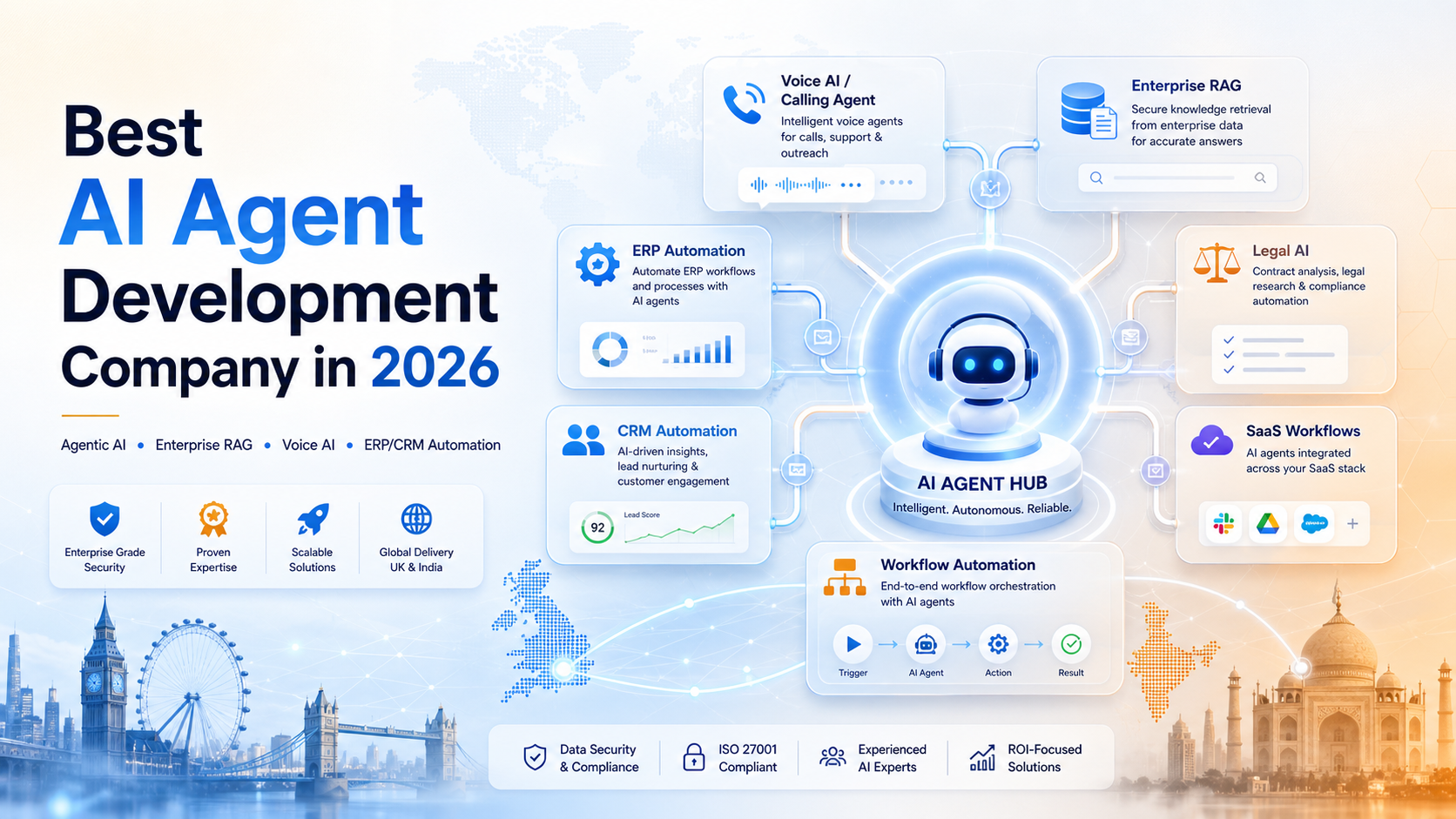
Why businesses need enterprise RAG for private AI search
This article is structured for better readability, SEO depth, and AI-first understanding across enterprise workflows, RAG systems, SaaS, legal tech, healthcare, ecommerce, and automation.
Enterprise RAG Development Company: Private AI Search for Business
Enterprise RAG development is the process of building private AI search systems that allow businesses to ask questions from their own documents, policies, CRM data, ERP records, legal files, SOPs, reports and internal knowledge bases. A strong enterprise RAG system combines large language models, vector search, data pipelines, permission control, retrieval logic, citations, human review and workflow automation.
Why businesses need enterprise RAG for private AI search
Businesses are creating more documents, data and knowledge than ever before. Teams store information across Google Drive, SharePoint, Notion, ERP systems, CRM platforms, emails, PDFs, legal files, customer tickets, invoices, training manuals and internal SOPs.
The problem is not lack of data. The problem is that business knowledge is scattered.
Employees waste time searching documents. Support teams repeat answers. Sales teams cannot quickly find the right proposal or case study. Legal teams spend hours reviewing files. Management teams depend on manual reporting.
This is where enterprise RAG becomes important.
Enterprise RAG allows a business to build a private AI search layer over its own information. Instead of asking a generic chatbot, employees can ask a secure business AI assistant questions like:
- What is our refund policy for enterprise clients?
- Which customer raised this issue last month?
- Summarize this contract and highlight risk clauses.
- Find the latest SOP for onboarding.
- Which sales proposal mentioned ERP automation?
- What is the status of this project based on internal notes?
- Which legal matter has the next hearing date?
For companies planning AI transformation in 2026, enterprise RAG is one of the most practical ways to start because it connects AI with real business knowledge.
What is enterprise RAG?
Enterprise RAG is a private AI architecture that retrieves relevant business information from internal data sources before generating an answer. RAG stands for Retrieval-Augmented Generation. It improves AI accuracy by grounding responses in company-approved documents, databases and knowledge systems.
In simple words, enterprise RAG gives your AI assistant a trusted memory.
A normal AI chatbot may answer from general internet training. An enterprise RAG system answers from your own business data.
This makes it useful for:
- Internal knowledge search
- Legal document review
- ERP and CRM support
- Customer support automation
- HR policy search
- Sales enablement
- Compliance workflows
- SOP automation
- Technical support
- Management reporting
Enterprise RAG is not only a chatbot. It is a search, retrieval, reasoning and workflow layer that can connect with business systems.
Why is RAG better than a normal chatbot for business?
A normal chatbot can answer general questions, but it may not know your internal documents, latest policies, client records or private processes.
Enterprise RAG is different because it retrieves relevant company information before answering.
Area | Normal Chatbot | Enterprise RAG System |
|---|---|---|
Knowledge source | General model knowledge | Private company documents and systems |
Accuracy | May give generic answers | Answers are grounded in retrieved business data |
Citations | Usually missing | Can show source documents and references |
Security | Often limited | Can include access control and permissions |
Business use | Basic Q&A | Search, support, workflow automation and decision support |
Updates | Depends on model training | Updates when your documents/data update |
Trust | Lower for business decisions | Higher when retrieval and citations are used |
For business use, the most important difference is trust.
Teams do not only want an AI answer. They want to know where the answer came from.
How does enterprise RAG work?
Enterprise RAG works in a structured pipeline.
1. Data collection
The system connects to business data sources such as PDFs, documents, CRM records, ERP data, emails, databases, helpdesk tickets, legal files, spreadsheets or internal knowledge bases.
2. Data cleaning and preparation
Documents are cleaned, normalized and divided into meaningful chunks. This step is important because poor chunking creates poor answers.
3. Embedding and vector storage
Each document chunk is converted into embeddings and stored in a vector database. This allows the system to find semantically similar information, not just exact keyword matches.
4. User query
A user asks a question such as: “What are the payment terms for this client?”
5. Retrieval
The system searches the vector database and retrieves the most relevant document sections, records or knowledge snippets.
6. Generation
The LLM uses the retrieved information to generate a business answer.
7. Citations and validation
A good enterprise RAG system shows source references, confidence signals or document links so users can verify the answer.
8. Workflow action
In advanced systems, the AI can also trigger workflows such as creating a ticket, drafting an email, updating CRM, generating a report or sending a task for approval.
Enterprise RAG architecture
Layer | Purpose |
|---|---|
Data source layer | Connects documents, CRM, ERP, database, emails and knowledge systems |
Processing layer | Cleans, chunks and prepares business content |
Embedding layer | Converts text into vector representations |
Vector database layer | Stores and retrieves semantically relevant knowledge |
Retrieval layer | Finds the best matching business context |
LLM layer | Generates answers using retrieved information |
Security layer | Manages permissions, roles and private access |
Citation layer | Shows source references and document links |
Workflow layer | Connects answers with business actions |
This architecture is useful because it separates business knowledge, retrieval logic, security and AI output.
What business problems does enterprise RAG solve?
Enterprise RAG solves problems where information exists but is hard to find, summarize or use.
1. Internal knowledge search
Teams can ask questions from company documents, SOPs, HR policies, training material and internal notes.
2. Customer support automation
Support teams can answer customer questions from manuals, tickets, product documents and previous resolutions.
3. Legal AI and document review
Law firms and legal teams can search case files, court orders, contracts, client notes and compliance documents.
This connects strongly with Caz Brain Group’s legal AI work through Matter-Wise Legal AI.
4. ERP and CRM automation
Teams can ask questions from customer records, order history, invoices, project status and workflow data.
5. Sales enablement
Sales teams can quickly find proposals, pricing notes, case studies, pitch documents and customer-specific information.
6. Manufacturing knowledge automation
Manufacturing companies can search SOPs, machine manuals, maintenance logs, compliance documents and production reports.
7. Management reporting
Leadership teams can ask business questions and receive summarized answers from internal data.
Why enterprise RAG matters in 2026
In 2026, businesses are moving from AI experiments to practical AI systems.
The first phase of AI adoption was about chatbots and content generation. The next phase is about AI connected to business data.
This is why enterprise RAG matters.
A company does not get full value from AI until AI can understand its own data, processes, documents and workflows.
Enterprise RAG helps businesses move from:
- Generic AI answers to private business answers
- Manual search to AI-powered search
- Static documents to interactive knowledge systems
- Repeated support work to automated support assistance
- Isolated data to connected AI workflows
- Basic chatbots to business copilots
For high-growth companies, enterprise RAG becomes the foundation for AI agents, AI copilots, workflow automation and private business intelligence.
Enterprise RAG vs fine-tuning
Many businesses ask whether they need RAG or fine-tuning.
The answer depends on the use case.
Requirement | Enterprise RAG | Fine-Tuning |
|---|---|---|
Search private documents | Best choice | Not ideal |
Keep answers updated | Easier | Requires retraining |
Show citations | Strong | Weak |
Use company knowledge | Strong | Limited unless trained |
Teach style or behavior | Moderate | Strong |
Reduce hallucination | Strong when retrieval is good | Depends on training |
Compliance use cases | Stronger with source control | More complex |
Cost to update data | Lower | Higher |
For most business knowledge systems, RAG is the better first step because company data changes often.
Fine-tuning can be useful later for tone, formatting, classification or domain-specific behavior, but it should not replace retrieval when the system needs current company knowledge.
What makes an enterprise RAG system reliable?
A reliable enterprise RAG system needs more than a vector database and an LLM.
It needs proper engineering.
Important reliability factors include:
- Clean data ingestion
- Correct document chunking
- Metadata tagging
- Semantic search tuning
- Hybrid search where needed
- Role-based access control
- Source citations
- Hallucination checks
- Human approval workflows
- Logging and monitoring
- Feedback loops
- Data refresh pipelines
- Secure deployment
- API integration with business tools
A weak RAG system may look impressive in a demo but fail in real business use.
A strong RAG system is built for accuracy, security, scale and workflow integration.
What industries can use enterprise RAG?
Enterprise RAG can be used in almost every industry where teams depend on documents, records and knowledge.
Industry | Enterprise RAG Use Case |
|---|---|
Legal | Search court orders, contracts, case files and client notes |
Real estate | Search property documents, buyer enquiries, project details and pricing |
Manufacturing | Search SOPs, manuals, maintenance logs and compliance documents |
SaaS | Search product docs, support tickets, release notes and customer data |
Healthcare admin | Search policy documents, process notes and operational records |
Education | Search course material, student support documents and institutional policies |
Finance | Search reports, compliance documents and client records |
HR | Search employee policies, onboarding documents and training material |
Customer support | Search product manuals, FAQs and previous resolutions |
Enterprise operations | Search internal knowledge across departments |
This is why enterprise RAG is a strong AI investment for businesses that want practical automation.
What is private AI search for business?
Private AI search is a secure AI-powered search system that answers questions from a company’s internal documents and data instead of public internet knowledge.
It helps employees find accurate answers faster while keeping company information private.
Private AI search can be used for:
- Internal document search
- Company knowledge assistant
- Client file search
- Legal document search
- ERP/CRM data search
- Policy and SOP search
- Sales knowledge search
- Technical support search
- Compliance knowledge search
For many businesses, private AI search is the first useful AI product they should build.
What is the Caz Brain enterprise RAG development approach?
Caz Brain Group builds enterprise RAG systems as practical business software, not only AI demos.
Our approach includes five layers.
1. Business knowledge audit
We first understand what data the business has, where it is stored, who uses it and what questions teams need to answer.
2. Data and document architecture
We organize data sources, document types, permissions, metadata and refresh requirements.
3. Retrieval design
We design how the system should search, rank and retrieve the most relevant information.
4. AI answer generation
We connect retrieval with LLM-based answer generation, summarization and reasoning.
5. Workflow integration
We connect the AI search system with CRM, ERP, dashboards, support tools, legal workflows, email, reports or admin panels.
This approach helps businesses move from AI concept to usable AI software.
Enterprise RAG development checklist
Checklist Item | Why It Matters |
|---|---|
Data source mapping | Identifies where business knowledge exists |
Permission model | Protects private and sensitive information |
Document chunking | Improves answer quality |
Vector database setup | Enables semantic search |
Metadata tagging | Improves retrieval precision |
Citation output | Builds trust in answers |
Feedback loop | Improves accuracy over time |
Admin dashboard | Helps manage documents and users |
Workflow integration | Turns answers into business actions |
Monitoring | Tracks usage, failures and quality |
How much does enterprise RAG development cost?
Enterprise RAG development cost depends on data complexity, number of integrations, user roles, security requirements, AI model selection and workflow automation.
A basic internal knowledge assistant may cost less than a full enterprise AI search platform.
General cost ranges:
RAG System Type | Typical Scope | Estimated Cost Range |
|---|---|---|
Basic RAG prototype | Upload documents, search and answer with citations | ₹3 lakh – ₹8 lakh |
Business knowledge assistant | Multiple document types, user login, admin panel and feedback | ₹8 lakh – ₹25 lakh |
Enterprise RAG platform | CRM/ERP integration, permissions, dashboards and monitoring | ₹25 lakh – ₹75 lakh |
Advanced AI workflow system | RAG + AI agents + automation + custom dashboards | ₹75 lakh – ₹1.5 crore+ |
These ranges are indicative. Actual pricing depends on business requirements.
Enterprise RAG use case examples
Legal AI assistant
A legal team can upload court orders, case files, hearing notes and client documents. The AI assistant can summarize matters, find next hearing dates, extract obligations and generate client-ready drafts.
Related case study:AI Workflow Automation for Enterprise Operations
Sales knowledge assistant
A sales team can search proposals, pricing sheets, case studies and client notes. The AI can help prepare pitch content faster.
ERP/CRM AI assistant
A business can connect ERP and CRM data so users can ask questions about orders, customers, invoices, project status and support issues.
Manufacturing SOP assistant
A manufacturing team can search machine manuals, SOPs, quality reports and maintenance logs.
SaaS support assistant
A SaaS company can search documentation, release notes, support tickets and product workflows to help support teams respond faster.
Enterprise RAG and AI agents
Enterprise RAG becomes more powerful when combined with AI agents.
RAG helps the AI find knowledge. AI agents help the system take action.
For example:
- RAG finds the customer policy.
- The AI agent drafts the email.
- The workflow sends it for approval.
- The CRM is updated.
- A support ticket is created.
This is the future of business automation.
RAG gives the agent knowledge. Workflow automation gives the agent execution power.
Why choose Caz Brain Group as an enterprise RAG development company?
Caz Brain Group is positioned strongly for enterprise RAG because we combine AI development, custom software engineering, workflow automation and business system integration.
We build:
- Enterprise RAG systems
- Private AI search platforms
- AI knowledge assistants
- ERP/CRM AI automation
- Legal AI systems
- AI agents
- SaaS AI platforms
- Voice AI workflows
- Mobile and web software
- Admin dashboards
- Workflow automation systems
Caz Brain Group serves businesses across India, the United Kingdom and global markets with a hybrid approach: business understanding, AI engineering and scalable software delivery.
How enterprise RAG supports the Caz Brain AI development cluster
This article supports the broader Caz Brain Group AI development cluster.
Related pages:
Best AI Development Company in UK and India
AI Development Company in India for AI Agents, RAG and Automation
AI Workflow Automation Case Study
What should businesses prepare before building enterprise RAG?
Before starting enterprise RAG development, a business should prepare:
- List of documents and data sources
- User roles and permission rules
- Main questions teams need to ask
- Required integrations such as CRM, ERP or Google Drive
- Security and compliance requirements
- Preferred workflow actions
- Expected users and departments
- Admin and reporting requirements
- Budget and timeline
- Success metrics
A clear preparation phase reduces development risk and improves output quality.
Expert Review
This article was reviewed by Vishwanand Srivastava, Founder & CEO of Caz Brain Group.
Vishwanand Srivastava works across AI development, software engineering, AI agents, enterprise RAG, workflow automation, Legal AI, SaaS systems and business automation platforms. The recommendations in this article are based on Caz Brain Group’s practical experience building AI/software products, private AI search systems, workflow automation and enterprise-grade business applications.
Reviewed focus areas:
- Enterprise RAG
- AI agents
- Private AI search
- AI knowledge base automation
- ERP/CRM automation
- Legal AI
- Software engineering
- AI workflow automation
Founder profile:
https://cazbraingroup.com/vishwanand-srivastava
Final thoughts
Enterprise RAG is one of the most practical AI systems for businesses in 2026.
It helps companies turn scattered documents and data into a private AI search system that employees can use every day.
The biggest benefit is not only faster search. The real benefit is better decision-making, stronger knowledge access, reduced manual work and the foundation for future AI agents.
Caz Brain Group helps businesses build enterprise RAG platforms, private AI search systems, AI knowledge assistants and AI workflow automation products.
If your business has documents, processes, CRM data, legal files, SOPs or internal knowledge that teams struggle to search, enterprise RAG can become a strong first step toward AI transformation.
Explore our main AI development pillar:Best AI Development Company in UK and India
Read our AI automation case study:AI Workflow Automation for Enterprise Operations
Frequently Asked Questions
What is enterprise RAG?
Enterprise RAG is a private AI architecture that retrieves relevant business information from internal documents, databases and systems before generating an answer. It helps businesses build secure AI search and knowledge assistants.
Private AI search is a secure AI-powered search system that answers questions from a company’s internal documents and data instead of public internet knowledge.
Private AI search is a secure AI-powered search system that answers questions from a company’s internal documents and data instead of public internet knowledge.
Why is RAG important for enterprise AI?
RAG is important because enterprise AI must answer from accurate, current and private business information. RAG helps reduce generic answers and supports citations, source control and business trust.
How much does enterprise RAG development cost?
Enterprise RAG development can range from ₹3 lakh for a basic prototype to ₹1.5 crore or more for advanced platforms with CRM/ERP integrations, permissions, dashboards and workflow automation.
Can enterprise RAG connect with ERP and CRM systems?
Yes. Enterprise RAG can connect with ERP, CRM, document storage, databases, support tools and internal systems to provide AI-powered search and workflow automation.
Is enterprise RAG secure?
Enterprise RAG can be secure when built with role-based access control, private data pipelines, permission checks, logging, secure hosting and careful model/data handling.
Does Caz Brain Group build enterprise RAG systems?
Yes. Caz Brain Group builds enterprise RAG systems, private AI search platforms, AI knowledge assistants, Legal AI systems, ERP/CRM automation and AI workflow automation products.
What is the difference between RAG and fine-tuning?
RAG retrieves current business knowledge from documents and systems before answering. Fine-tuning changes model behavior or style. For business knowledge search, RAG is usually the better first step.
Which industries can use enterprise RAG?
Enterprise RAG can be used by legal firms, SaaS companies, real estate businesses, manufacturing companies, finance teams, HR teams, customer support teams and enterprise operations teams.