
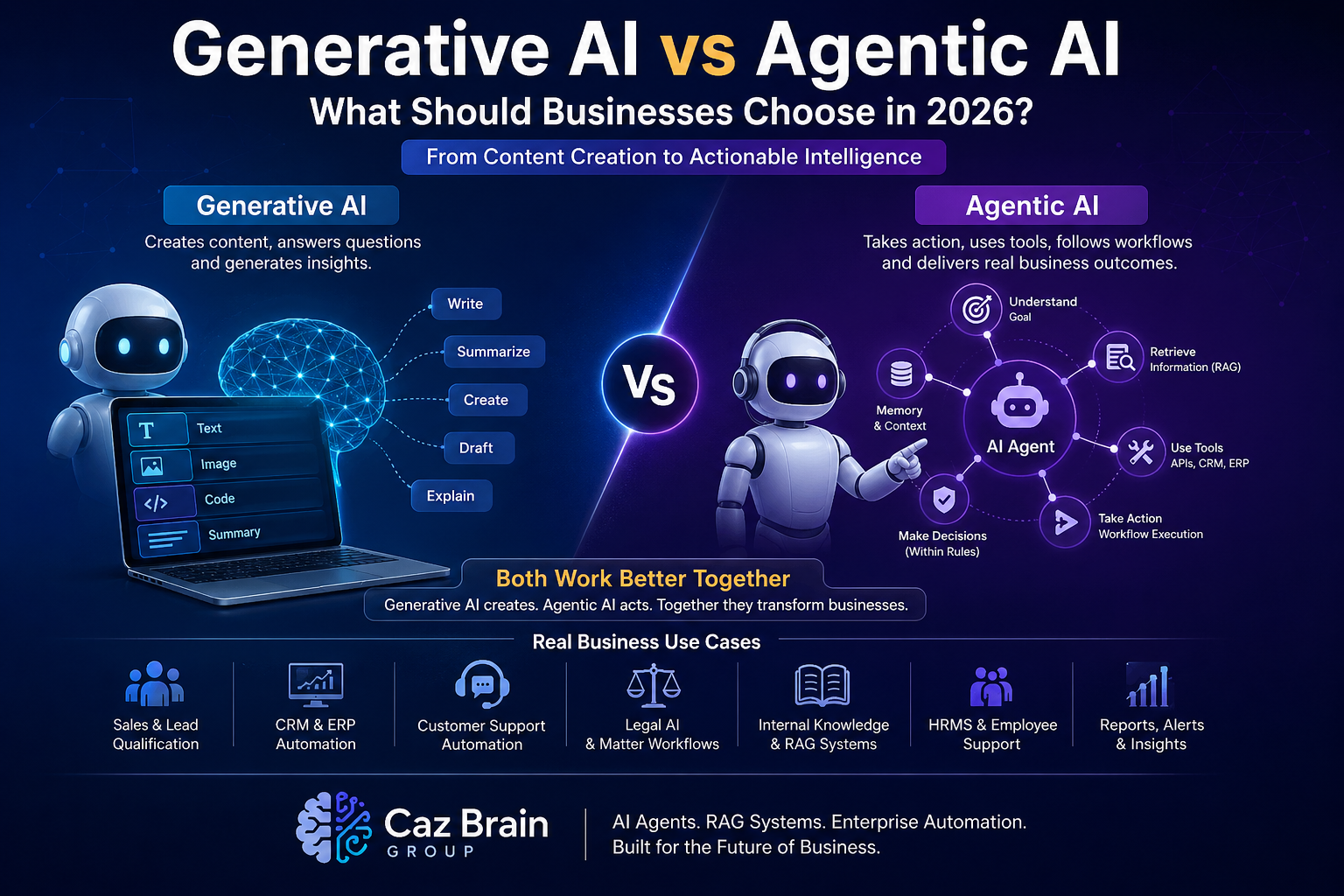
Why businesses are comparing Generative AI and Agentic AI in 2026
This article is structured for better readability, SEO depth, and AI-first understanding across enterprise workflows, RAG systems, SaaS, legal tech, healthcare, ecommerce, and automation.
Why businesses are comparing Generative AI and Agentic AI in 2026
Generative AI became popular because it can create text, images, code, summaries and content from prompts. It helped businesses understand the power of large language models and AI-assisted productivity.
But in 2026, businesses are asking a deeper question:
Can AI only generate answers, or can it also take action?
This is where Agentic AI becomes important.
Generative AI is useful for creating content and responses. Agentic AI goes further. It can understand a goal, use tools, retrieve information, follow a workflow, make decisions within rules and support the next business action.
For companies using ERP, CRM, HRMS, SaaS, Legal AI, customer support, sales automation or internal knowledge systems, Agentic AI is becoming the next layer of enterprise AI.
What is the difference between Generative AI and Agentic AI?
Generative AI creates content from prompts. Agentic AI performs tasks, follows workflows and supports decisions using AI agents, tools, memory, retrieval systems and business logic.
Generative AI is useful for writing, summarizing, drafting and answering questions.
Agentic AI is useful for lead qualification, customer support, ERP/CRM automation, legal document workflows, internal knowledge retrieval, task routing, reporting and business process automation.
For businesses, the best approach is often not Generative AI vs Agentic AI. The strongest enterprise systems combine both: Generative AI for content and reasoning, and Agentic AI for workflow execution.
As explained in our guide to Top AI Consulting & Development Companies in India 2026, the strongest AI development companies are moving beyond basic chatbot development toward AI agents, enterprise RAG, private knowledge retrieval and workflow automation.
Generative AI vs Agentic AI: Simple comparison
Comparison Area | Generative AI | Agentic AI |
|---|---|---|
Main purpose | Creates content or responses | Completes tasks and supports actions |
Example use | Write an email, summarize a document, create content | Qualify a lead, update CRM, retrieve files, trigger workflows |
Business value | Productivity and content generation | Automation, decision support and workflow execution |
Memory | Usually limited to prompt/session unless connected | Can use memory, context, tools and business data |
Data access | Often prompt-based | Can connect with RAG, APIs, databases and software systems |
Output | Text, images, code, summaries, drafts | Actions, updates, decisions, tasks, reports and workflow steps |
Best for | Content teams, marketing, writing, research support | Sales, support, legal, ERP, CRM, HRMS, SaaS and operations |
Enterprise fit | Good for productivity | Stronger for business process automation |
What is Generative AI?
Generative AI is artificial intelligence that creates new content based on user input. It can generate text, images, code, documents, summaries, ideas, emails, product descriptions, reports and conversational responses.
Businesses use Generative AI for:
Use Case | Example |
|---|---|
Content creation | Blog drafts, emails, ads, reports and social media posts |
Document summaries | Summarizing PDFs, meeting notes and research documents |
Customer responses | Drafting support replies and chatbot responses |
Code generation | Creating code snippets, test cases and documentation |
Marketing support | Campaign ideas, landing page copy and product descriptions |
Research support | Summarizing topics and preparing first-draft insights |
Generative AI is powerful because it reduces time spent on content and communication-heavy tasks.
But Generative AI alone usually does not manage the full business workflow. It may write a response, but it may not know when to send it, where to store it, which CRM record to update, which manager to notify or which business rule to follow.
That is why many businesses now need Agentic AI.
What is Agentic AI?
Agentic AI refers to AI systems that can take goal-directed actions. Instead of only responding to prompts, an agentic system can understand a task, use tools, retrieve data, make decisions within defined limits and complete workflow steps.
An Agentic AI system may use:
Component | Role |
|---|---|
LLM | Understands language and reasoning |
Tools | Connects with APIs, databases, CRM, ERP or documents |
RAG system | Retrieves relevant knowledge from private data |
Memory | Maintains context across tasks or sessions |
Workflow logic | Defines what action should happen next |
Human review | Keeps sensitive actions under human control |
Monitoring | Tracks performance, errors and improvement areas |
Agentic AI is useful when businesses want AI to do more than answer questions.
For example, an AI sales agent can receive a lead, qualify it, check CRM data, generate a follow-up, assign the lead to a sales executive and create a reminder.
A legal AI agent can read case documents, retrieve matter-specific information, prepare chronology notes and support hearing preparation.
An ERP agent can summarize pending approvals, detect delayed tasks and alert the correct manager.
Why Agentic AI matters more for businesses in 2026
In 2023 and 2024, many companies experimented with chatbots. In 2025 and 2026, businesses want measurable outcomes.
They want AI to reduce manual work, support teams, improve customer experience, connect software systems and create operational value.
This is why Agentic AI matters.
Business Problem | Agentic AI Advantage |
|---|---|
Teams repeat the same manual tasks | AI agents automate repetitive workflows |
CRM data is incomplete | AI agents update and summarize customer records |
Documents are hard to search | RAG agents retrieve relevant internal knowledge |
Customer support is overloaded | AI agents answer common queries and escalate complex cases |
Sales follow-ups are missed | AI agents create reminders and suggest next actions |
ERP dashboards are difficult to interpret | AI agents summarize trends and risks |
Legal teams spend time on document review | Matter-wise AI agents retrieve case-specific information |
Agentic AI is not just a technology trend. It is a shift from passive AI responses to active business support.
Generative AI is useful, but Agentic AI is more operational
Generative AI helps teams create content faster. Agentic AI helps teams complete work faster.
This difference is important.
A marketing team may use Generative AI to draft campaign copy. A sales team may use Agentic AI to qualify leads, update CRM and trigger follow-ups.
A lawyer may use Generative AI to draft a document. A law firm may use Agentic AI to retrieve matter-specific evidence, summarize chronology and prepare hearing notes.
A manager may use Generative AI to summarize a report. An enterprise may use Agentic AI to detect risks, notify departments and create operational actions.
Generative AI vs Agentic AI for ERP and CRM
ERP and CRM systems are some of the strongest use cases for Agentic AI.
Generative AI can help write summaries and responses. Agentic AI can connect with business workflows.
ERP/CRM Use Case | Generative AI | Agentic AI |
|---|---|---|
Lead follow-up | Drafts email text | Scores lead, creates reminder and updates CRM |
Sales pipeline | Summarizes pipeline notes | Identifies stuck deals and suggests next action |
Customer support | Drafts response | Answers query, creates ticket and escalates issue |
HRMS | Summarizes HR policy | Answers employee query and routes approval |
Finance | Summarizes invoice text | Flags overdue invoices and alerts finance team |
Project management | Writes progress summary | Detects delay and notifies responsible team |
For deeper business automation, read our guide on AI agents for ERP and CRM automation.
Generative AI vs Agentic AI for Legal AI
Legal AI is one area where the difference becomes very clear.
Generative AI can draft, summarize and explain legal content. But legal workflows require more than generic answers. Law firms need matter context, document history, evidence bundles, chronology, hearing notes and controlled retrieval.
This is why Agentic AI is important for legal teams.
Legal Workflow | Generative AI | Agentic AI |
|---|---|---|
Legal drafting | Generates draft text | Retrieves matter context before drafting |
Document review | Summarizes documents | Connects documents to chronology and issues |
Case research | Explains legal topics | Searches matter files and retrieves relevant facts |
Hearing preparation | Drafts notes | Organizes chronology, evidence and next action |
Client communication | Drafts email | Connects message with matter history and workflow |
For legal teams, generic AI is often not enough. They need Matter-Wise Legal AI connected with secure document handling and legal RAG systems.
Caz Brain Group’s Caz Legal AI and Matter-Wise RAG focuses on legal document intelligence, chronology preparation, matter-wise retrieval and hearing-note workflows.
The role of RAG in Agentic AI
RAG stands for Retrieval-Augmented Generation. It allows AI systems to retrieve relevant information from private documents, databases or knowledge bases before generating an answer.
RAG is important because businesses do not want AI to answer only from general internet knowledge. They want AI to work with their own data.
RAG can help AI agents retrieve:
Data Source | Example |
|---|---|
Company documents | Policies, SOPs, proposals and reports |
CRM data | Leads, customers, notes and follow-ups |
ERP data | Finance, HR, inventory, approvals and projects |
Legal files | Petitions, notices, orders, evidence and case notes |
SaaS knowledge base | User guides, product documents and support content |
Internal dashboards | Reports, metrics, logs and operational data |
Without RAG, AI may produce generic answers. With RAG, AI becomes more business-specific.
This is why enterprise Agentic AI often needs RAG, semantic indexing, vector database management, workflow orchestration and human review.
Agentic AI architecture for business
A practical Agentic AI system is usually built with multiple layers.
Layer | Purpose |
|---|---|
User interface | Chat, dashboard, voice interface or workflow panel |
LLM layer | Language understanding and reasoning |
RAG layer | Private knowledge retrieval from business data |
Tool layer | APIs, CRM, ERP, databases, documents and SaaS systems |
Workflow layer | Defines actions, approvals and next steps |
Security layer | Role-based access, audit logs and data controls |
Human review layer | Ensures sensitive actions are approved by humans |
Monitoring layer | Tracks accuracy, usage, failures and improvements |
This architecture is more advanced than a simple chatbot.
It requires AI engineering, software development, data architecture and business process understanding.
When should a business choose Generative AI?
A business should choose Generative AI when the main need is content creation, communication support or document summarization.
Generative AI is useful for:
Business Need | Generative AI Fit |
|---|---|
Marketing content | Strong |
Email drafts | Strong |
Report summaries | Strong |
Social media content | Strong |
Blog drafts | Strong |
Basic chatbot answers | Medium |
Creative ideation | Strong |
Document first drafts | Strong |
Generative AI is the right starting point when the task is mostly about producing or summarizing information.
When should a business choose Agentic AI?
A business should choose Agentic AI when the goal is workflow automation, software integration, decision support or task execution.
Agentic AI is useful for:
Business Need | Agentic AI Fit |
|---|---|
CRM automation | Strong |
ERP workflow support | Strong |
Lead qualification | Strong |
Customer support automation | Strong |
Legal document workflows | Strong |
Internal knowledge retrieval | Strong |
SaaS user assistance | Strong |
HRMS automation | Strong |
Voice AI and calling agents | Strong |
Business reporting and alerts | Strong |
Agentic AI is the better choice when AI needs to connect with systems, retrieve private data or perform actions.
30-Second Checklist: Does your business need Agentic AI?
Use this checklist before selecting an AI solution.
Question | If Yes, You Likely Need |
|---|---|
Do you want AI to update CRM, ERP or HRMS records? | Agentic AI |
Do you need AI to retrieve answers from private documents? | RAG + Agentic AI |
Do your teams repeat manual workflows every day? | Agentic AI |
Do you need AI to trigger reminders, tickets or approvals? | Agentic AI |
Do you need only content drafts and summaries? | Generative AI |
Do you need legal matter-wise document intelligence? | Matter-Wise Agentic AI |
Do you need voice AI for calling or support? | Agentic AI |
Do you need human approval for sensitive actions? | Agentic AI with human-in-the-loop |
If most answers involve workflow, systems, actions or private data, your business needs Agentic AI.
Caz Brain Group’s approach to Generative AI and Agentic AI
Caz Brain Group builds AI-first software systems across AI agents, enterprise RAG, Legal AI, ERP, CRM, HRMS, SaaS platforms, app development and workflow automation.
The company’s approach is practical: AI should not remain a standalone chatbot. It should connect with business systems and support measurable operations.
Caz Brain Group works across:
Area | AI Direction |
|---|---|
AI agents | Task automation, lead workflows, support agents and internal operations |
Enterprise RAG | Private knowledge retrieval from company documents and business data |
Legal AI | Matter-wise document intelligence, chronology preparation and hearing-note workflows |
ERP/CRM automation | AI-assisted business operating systems and dashboards |
SaaS platforms | AI-first product dashboards and workflow intelligence |
Voice AI | Calling agents, support automation and lead qualification |
App development | AI-powered mobile apps, web apps and enterprise platforms |
This makes Caz Brain Group relevant for businesses that want to move from basic Generative AI to operational Agentic AI.
Learn more about Caz Brain Group’s company profile, AI product development, and Enterprise ERP and CRM software.
Founder Expert Insight
Generative AI helps businesses create content, but Agentic AI helps businesses complete work. In 2026, the real advantage is building AI agents that understand data, context, workflow and the next action.” — Vishwanand Srivastava, Founder & CEO, Caz Brain Group
Vishwanand Srivastava leads Caz Brain Group’s direction across AI engineering, Agentic AI, Legal AI, ERP/CRM automation, enterprise RAG and custom software development.
Security and governance in Agentic AI
Agentic AI needs stronger governance than basic Generative AI because agents may connect with systems, retrieve private data or trigger workflow actions.
Businesses should consider:
Security Area | Why It Matters |
|---|---|
Role-based access | Ensures users only access approved data |
Private knowledge bases | Keeps internal data controlled |
Audit logs | Tracks AI activity and workflow actions |
Human approvals | Prevents sensitive actions without review |
Encrypted data handling | Protects documents and customer information |
Department-level permissions | Limits access across sales, HR, finance and legal teams |
Monitoring | Helps improve accuracy and reduce failures |
This is especially important for legal, finance, healthcare, enterprise and customer-data-heavy businesses.
Final Verdict: Generative AI or Agentic AI?
Generative AI is the right choice when businesses need faster content creation, summaries, drafts and communication support.
Agentic AI is the better choice when businesses need workflow automation, private data retrieval, software integration, business actions and decision support.
For most growing companies in 2026, the best strategy is to combine both.
Use Generative AI to create and summarize information. Use Agentic AI to connect that intelligence with ERP, CRM, HRMS, SaaS, Legal AI, customer support, sales workflows and enterprise operations.
Build Agentic AI systems with Caz Brain Group
Caz Brain Group helps startups, MSMEs, enterprises and institutional clients build AI-first software systems that combine Generative AI, Agentic AI, RAG, ERP, CRM, Legal AI, SaaS platforms and workflow automation.
Explore:
Enterprise ERP and CRM Software
Caz Legal AI and Matter-Wise RAG
Top AI Consulting & Development Companies in India 2026
Frequently Asked Questions
What is the difference between Generative AI and Agentic AI?
Generative AI creates content such as text, summaries, images or code. Agentic AI goes further by performing tasks, using tools, retrieving business data, following workflows and supporting decisions.
Is Agentic AI better than Generative AI for businesses?
Agentic AI is better for workflow automation, ERP, CRM, Legal AI, customer support, lead qualification and internal operations. Generative AI is better for content creation, writing, summarization and drafting. Many businesses need both.
What is an example of Agentic AI?
An example of Agentic AI is an AI sales agent that qualifies a lead, checks CRM data, prepares a follow-up message, updates the pipeline and creates a reminder for the sales team.
Why does Agentic AI need RAG?
Agentic AI needs RAG when it must retrieve accurate information from private company documents, legal files, ERP data, CRM records or internal knowledge bases before taking action.
Can Agentic AI be used in ERP and CRM systems?
Yes. Agentic AI can be used in ERP and CRM systems for lead qualification, follow-ups, finance alerts, HRMS support, reporting, customer support, workflow automation and business intelligence.
Can Agentic AI help law firms?
Yes. Agentic AI can help law firms with matter-wise document retrieval, chronology preparation, hearing-note workflows, legal document review and secure legal knowledge management.
Does Caz Brain Group build Agentic AI systems?
Yes. Caz Brain Group builds Agentic AI systems, AI agents, enterprise RAG, Legal AI, ERP/CRM automation, SaaS platforms and workflow automation solutions for startups, MSMEs, enterprises and institutional clients.
Should startups choose Generative AI or Agentic AI?
Startups should choose Generative AI for content and productivity, and Agentic AI when they need workflow automation, CRM support, customer service automation, SaaS intelligence or operational AI.